|
Jefferson River group produces builder's guide for streamside construction
by Greg Lemon of The Madisonian, 11/30/2011
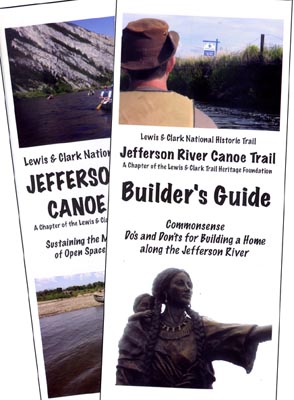
A local group focused on recreating and preserving the Jefferson River has developed two brochures with the help of a small grant.
The Jefferson River Canoe Trail is a chapter of the Lewis and Clark
Heritage Foundation and was formed by Thomas Elpel of Pony.
The canoe trail recently was awarded a $750 grant from the heritage foundation to print 1,000 copies each of two brochures - one
explaining the canoe trail and another a builders guide for building along the Jefferson River.
The goal behind both brochures is really to educate people about the fact the Jefferson River is a natural and historical treasure, Elpel
said.
"It's kind of like having a long, skinny national park in our backyard," he said. "It's really up to us, the people that live here,
to determine the future of the Jefferson and all of our wonderful
rivers in southwest Montana."
Besides the brochures, the group also has produced a set of maps of the Jefferson River, which it offers for a suggested donation.
As the name implies, the Jefferson River Canoe Trail outlines access and recreation along the Jefferson River, Elpel said.
Currently, the camping along the river is limited to a few spots of Bureau of Land Management land and below the normal high water mark, he said. But the group is hoping to work with landowners to develop
other primitive camping spots, he said.
The brochures will hopefully help spread the word about the group and its work, Elpel said.
"This is a way of reaching out and letting people know about our group and what we do," he said.
The builder's guide is also a tool that is geared to help inform property owners about the benefits of building back from the river and protecting the stream banks, Elpel said.
"I think one of the things that happen is people don't really think through the particulars of what is involved with living by the river,"
he said.
Some of the downsides of building on the river include lower temperatures (particularly in the winter), mosquitoes and the need to
stabilize riverbanks to protect structures, Elpel said.
"The Jefferson River is being loved to death," reads the brochure. "It's easy to imagine that one house won't really change anything, but
it doesn't work that way.
There is always one more house. The Jefferson is at risk of becoming a rip-rapped channel lined with houses."
Though the brochure was developed independent of the public discussion streamside setbacks on the Madison River, it's not hard to see the parallels.
Last month the Madison County Commissioners decided not to implement a streamside setback regulation on the Madison River. Instead the commissioners are looking to develop building guidelines for along the
Madison River. However, how these guidelines will be developed and
what they will recommend is still unknown.
Madison County is currently going through a process to revise their growth policy. It's possible streamside setback guidelines could be
part of the revision process, said Charity Fechter, planning director
for Madison County.
"That is part of what we're looking at as part of the growth policy update as to how to deal with the guidelines," Fechter said.
The planning board is currently analyzing the feedback they received from a survey they recently put out concerning the growth policy. The Jefferson River Canoe Trail submitted their builder's guide as part of
their comments, Elpel said.
For more information about the canoe trail, go on to their website at www.JeffersonRiver.org.
Used with permission of The Madisonian
Return to Jefferson River Canoe Trail Home Page.
Commissioners vote against setback regulations, look to voluntary guidelines
by Ben Coulter of The Madisonian, 10/26/2011
More than a year after receiving a recommendation on streamside setbacks from the county planning board, Madison County Commissioners decided Tuesday against streamside setback regulations for the Madison River.
The commissioners instead chose unanimously to use the planning board's proposal as voluntary guidelines for landowners along the Madison River wishing to build on their property.
"The Madison River is certainly a national treasure," commissioner Dan Happel said at Tuesday's meeting. "But I also believe in the rights of individuals to use their property."
The decision comes after a drawn out process that started nearly four years ago, when the commissioners decided to initiate a streamside setback citizen advisory committee to look into the issue of setbacks along the Madison and Jefferson River and its tributaries.
The goal was to address land that didn't fall under the scope of the subdivision regulations, which called for a 500-foot setback on the Madison River.
This citizen committee met for nearly two years on the topic and ultimately couldn't reach a complete consensus on the issue. However they recommended a regulation to the Madison County Planning Board of a minimum of 75-foot setbacks on the Madison and Jefferson River and 50-foot setbacks on the tributaries.
The Madison County Planning Board took the recommendation, and dropped the Jefferson River from the regulation and increased the building setbacks to 300 feet. This included a 500-foot jurisdictional area and 150-foot streamside buffer zone.
Ultimately, the final decision rested with the county commissioners, who chose to take neither recommendation for a setback regulation, but rather go with voluntary guidelines, expressing deep concerns about infringement of private property rights.
"I don't think that adding layer upon layer of regulation is the way to solve the problem," Happel continued. "The way to solve problems is by allowing people to use their ingenuity and use their capacities and make it happen through a free process to protect liberty."
Commissioner Dave Schulz indicated that support for and opposition to the proposal was fairly even among concerned parties. He emphasized the process for establishing streamside protections on the Madison River, to some degree or another, began decades ago, and the county planning board has done extensive research into the issue.
"We know there is an incredible amount of passion, that not everybody is of the same thought exactly, and a lot of people have put a lot of time and thought into this," Schulz said.
Commissioners expressed their confidence in Madison Valley landowners' ability to take initiative and manage their property the way they see best, without regulation from the county.
"The folks in the Madison Valley are good stewards of their own property, otherwise they lose money," said commissioner Jim Hart. "I don't think that goes too far away from someone who owns an acre or 500 feet."
Happel favored the proposal as a guideline, but not as regulation.
"I would support any effort to protect the environment, the river, the resources of our nation and be good stewards, but it has to be through a voluntary process," he said. "We will do everything we can to have people comply as long as its voluntarily, and we will do everything in our power to make sure that the Madison River remains a very pristine, very nice river."
Used with permission of The Madisonian
Return to Jefferson River Canoe Trail Home Page.
On the Jefferson: Sprawl Prompts Study of Setbacks
by Nick Gevock of The Montana Standard, 04/08/2006
A watershed group is considering whether counties need to implement building setbacks along the Jefferson River to prevent the sprawl of homes that have been built up along other Montana rivers.
The Jefferson River Watershed Council this week formed a committee that will study setbacks and other development issues in the floodplain along the river.
The move was spurred largely by the rapid sprawl that has put homes right along the Yellowstone, Bitterroot and other Montana rivers, said Gary Nelson, a Jefferson Valley rancher and council chairman.
"Probably what has sparked the interest is a drive from Jefferson County to other rivers to see what has been done," he said. "We're just going to look at the whole issue of land use in the floodplain." The council is only an advisory group and any regulations would have to be approved by the counties that the river flows through, which are Madison, Jefferson, Gallatin and Broadwater.
Madison and Gallatin counties have minimum setbacks for new lots created by subdivision along rivers, and Madison County last year approved a 150-foot setback along the Big Hole River for all property.
Nelson said as a rancher with river front property, he's concerned about subdivisions next door can cause problems for ranchers.
But property advocates showed up at a council meeting Wednesday night to voice their opposition to any setbacks. Among them was Leita Beardsley, who lives near Three Forks and was chosen to sit on the committee.
She said she's opposed to a private group taking on land use planning, which should be handled by local governments. And Beardsley said the setbacks would amount to an illegal takings because it would drop river front property values.
When people do build in inappropriate places along a river and get flooded out, they should be responsible for paying for their actions, Beardsley said. But those few instances don't justify an across-the-board regulation.
"I don't want people to be banned from doing that when there could be some perfectly good building sites within 150 feet of the river," she said. "If people built too close to the river, it's their own fault and they're own tough luck." But Nelson said the property rights argument cuts both ways. When homes get built up along rivers, riprap is often dumped along stream banks to protect them.
That just forces the river into a smaller channel to ultimately flood someone else out.
Jefferson County Commissioner Ken Weber, who sits on the committee, said as a local official his concern is public safety. Homes along stream banks means septic tanks and wastewater reaching the streams and those homes are also at risk during floods.
"If you build too close to it, your house becomes in danger and even your life becomes in danger," he said. "The town of Livingston is a prime example of the problems that have been run into and the tremendous amount of money spent to try to keep people safe."
Used with permission of the Montana Standard.
|


 Jefferson River Chapter Membership: Join us Today!